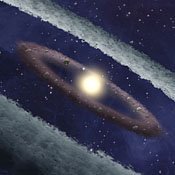
Picture Credit & Copyright: James Vernacotola
Get all our blog postings delivered in your inbox.Type your Email address Here
For more Click Teentweensblog
Follow us On Twitter
Get all our blog postings delivered in your inbox.Type your Email address Here
For more Click Teentweensblog
Follow us On Twitter
The Hubble Space Telescope (HST) is a space telescope that was carried into orbit by the Space Shuttle Discovery in April 1990. It is named after the American astronomer Edwin Hubble. Although not the first space telescope, the Hubble is one of the largest and most versatile, and is well-known as both a vital research tool and a public relations boon for astronomy. The HST is a collaboration between NASA and the European Space Agency, and is one of NASA's Great Observatories, along with the Compton Gamma Ray Observatory, the Chandra X-ray Observatory, and the Spitzer Space Telescope.
Space telescopes were proposed as early as 1923. The Hubble was funded in the 1970s, with a proposed launch in 1983, but the project was beset by technical delays, budget problems, and the Challenger disaster. When finally launched in 1990, scientists found that the main mirror had been ground incorrectly, severely compromising the telescope's capabilities. However, after a servicing mission in 1993, the telescope was restored to its intended quality. Hubble's position outside the Earth's atmosphere allows it to take extremely sharp images with almost no background light. Hubble's Ultra Deep Field image, for instance, is the most detailed visible-light image ever made of the universe's most distant objects. Many Hubble observations have led to breakthroughs in astrophysics, such as accurately determining the rate of expansion of the universe.
The Hubble is the only telescope ever designed to be serviced in space by astronauts. To date, there have been four servicing missions. Servicing Mission 1 took place in December 1993 when Hubble's imaging flaw was corrected. Servicing missions 2, 3A, and 3B repaired various sub-systems and replaced many of the observing instruments with more modern and capable versions. However, following the 2003 Columbia Space Shuttle disaster, the fifth servicing mission was canceled on safety grounds. After spirited public discussion, NASA reconsidered this decision, and administrator Mike Griffin gave the green light for one final Hubble servicing mission. This was planned for October 2008, but in September 2008, another key component failed. The servicing mission was postponed until May 2009 at which time it was carried out as the STS-125, Atlantis, to allow this unit to be replaced as well.
The planned repairs to the Hubble, which are currently underway, should allow the telescope to function until at least 2014, when its successor, the James Webb Space Telescope (JWST), is due to be launched. The JWST will be far superior to Hubble for many astronomical research programs, but will only observe in infrared, so it would complement (not replace) Hubble's ability to observe in the visible and ultraviolet parts of the spectrum.
The famous Hubble telescope is now 19 years old.Take a look at some of the extraordinarily great pictures it has brought us since 1990. Astronauts are due to visit Hubble for the final time next month. Here F. Story Musgrave is anchored on the Space Shuttle Endeavor's robotic arm, during Hubble's first servicing mission in 1993.
 Hubble took pictures of all the solar system's planets apart from Mercury and Earth. In this 2003 image of Uranus bot
 The Eagle Nebula (M16) was captured by Hubble in 1995. The pillars are made from hydrogen gas and dust. The nebula is 7,000 light years from Earth.
 A 'Light Echo' illuminates dust around the supergiant star V838 Monocerotis, 20,000 light years away. It was pictured in 2005 and 2006
 The gaseous outer layers of a Sun-like star glow in space in this 2008 image, after being expelled as the star reaches the end of its life. The nebula NGC 2818 will disperse into space, leaving behind only the star's hot, dense core, known as a white dwarf.
 2001: A swirling dust band around the nucleus of the 'Black Eye Galaxy' M64, roughly 17 million light-years from Earth. The inner dust is travelling in the opposite direction to the outer region. Astronomers believe M64 absorbed another galaxy.
The comprehensive mapping, with resolutions of up to five meters, will help the country plan future missions to the moon
These images are currently being analyzed and will undoubtedly prove invaluable to the scientific community. The ISRO chief said that while there were many lunar missions in the past, none of them has been able to provide comprehensive data in the form of images so detailed.
The Chandrayaan has been able to capture images of the lunar surface and get a complete picture of the moon with resolutions of up to five meters. Compare this with earlier missions, which capture images with a 100-meter resolution and that too of a very limited area.
The images from the mission will be used to study the composition of the lunar surface and to learn in detail the mineral composition of the moon. The comprehensive mapping will also help the country plan future missions to the moon, he said.
The chairman, speaking during an event, added that ISRO is blazing all guns and expects the country to execute its first manned moon mission by 2015!
Get all our blog postings delivered in your inbox.Type your email address Here For more Click Teentweensblog