A guy from Aurangabad,Bihar,India has threatened to kill US president Barack Obama,if he doesnt get Kareena Kapoor.The guy,named Ranjan Kumar is in love with Kareena Kapoor since a very long time.The guy also tried to visit Kareena Kapoor many times in her home.But the guards did not allow him.Finally he called The US Ambassy and threatened to kill President Obama.
The call was made 5 days back.After getting the news from the US Ambassy the DGP of Bihar Police.the guy was arrested immediately.Surprisisngly,police has come to know that the guy knows the phone numbers of not only US ambassy and presidents,but also the numbers of other countries president also.The tried called several times to thses numbers for help.But after being refused by them he took this "filmy" step.
The Police is suspepcting that the guy is mentally disturbed.But since no such evidence is found from his past activities police is continuing the interrogation to make sure.After all,it is a question of US President's life after all.
Let's see what happens.
Source:This report has been published in a Bengali Daily newspaper Anandabazar Patrika,on 11 th May 2009
Get all our blog postings delivered in your inbox.Type your Email address Here
For more ClickTeentweensblog Get assured income of $25 within 20 minutes.Sign Up Now
Coca-Cola has one of the most recognizable images in the world and although Coke knows it would be suicide to discard their classic logo, what they have done for the summer season is revamp the classic Coke look. Coca-Cola has officially launched a series of five cans, all with varying scenes of summer on them including aviators, beach balls, surfboards, the American flag, and BBQ’s. These cans are flirting with both what people know to be classic as well as creative and innovative marketing strategy.
Get all our blog postings delivered in your inbox.Type your Email address Here
In mathematics, chaos theory describes the behavior of certain dynamical systems – that is, systems whose states evolve with time – that may exhibit dynamics that are highly sensitive to initial conditions (popularly referred to as the butterfly effect). As a result of this sensitivity, which manifests itself as an exponential growth of perturbations in the initial conditions, the behavior of chaotic systems appears to be random. This happens even though these systems are deterministic, meaning that their future dynamics are fully defined by their initial conditions, with no random elements involved, this behavior is known as deterministic chaos, or simply chaos.
Chaotic behavior is also observed in natural systems, such as the weather. This may be explained by a chaos-theoretical analysis of a mathematical model of such a system, embodying the laws of physics that are relevant for the natural system.
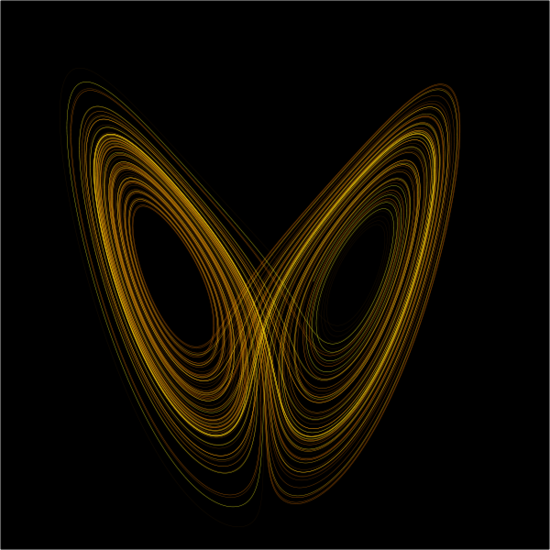
A plot of the Lorenz attractor for values r = 28, σ = 10, b = 8/3
Overview
Chaotic behavior has been observed in the laboratory in a variety of systems including electrical circuits, lasers, oscillating chemical reactions, fluid dynamics, and mechanical and magneto-mechanical devices. Observations of chaotic behavior in nature include the dynamics of satellites in the solar system, the time evolution of the magnetic field of celestial bodies, population growth in ecology, the dynamics of the action potentials in neurons, and molecular vibrations. Everyday examples of chaotic systems include weather and climate. There is some controversy over the existence of chaotic dynamics in plate tectonics and in economics.
Systems that exhibit mathematical chaos are deterministic and thus orderly in some sense; this technical use of the word chaos is at odds with common parlance, which suggests complete disorder. However, even though they are deterministic, chaotic systems show a strong kind of unpredictability not shown by other deterministic systems.
A related field of physics called quantum chaos theory studies systems that follow the laws of quantum mechanics. Recently, another field, called relativistic chaos,[6] has emerged to describe systems that follow the laws of general relativity.
This article tries to describe limits on the degree of disorder that computers can model with simple rules that have complex results. For example, the Lorenz system pictured is chaotic, but has a clearly defined structure. Bounded chaos is a useful term for describing models of disorder.
History
The first discoverer of chaos was Henri Poincaré. In the 1880s, while studying the three-body problem, he found that there can be orbits which are nonperiodic, and yet not forever increasing nor approaching a fixed point.In 1898 Jacques Hadamard published an influential study of the chaotic motion of a free particle gliding frictionlessly on a surface of constant negative curvature. In the system studied, "Hadamard's billiards," Hadamard was able to show that all trajectories are unstable in that all particle trajectories diverge exponentially from one another, with a positive Lyapunov exponent.
Much of the earlier theory was developed almost entirely by mathematicians, under the name of ergodic theory. Later studies, also on the topic of nonlinear differential equations, were carried out by G.D. Birkhoff,[10]A. N. Kolmogorov,M.L. Cartwright and J.E. Littlewood, and Stephen Smale.[15] Except for Smale, these studies were all directly inspired by physics: the three-body problem in the case of Birkhoff, turbulence and astronomical problems in the case of Kolmogorov, and radio engineering in the case of Cartwright and Littlewood.[citation needed] Although chaotic planetary motion had not been observed, experimentalists had encountered turbulence in fluid motion and nonperiodic oscillation in radio circuits without the benefit of a theory to explain what they were seeing.
Despite initial insights in the first half of the twentieth century, chaos theory became formalized as such only after mid-century, when it first became evident for some scientists that linear theory, the prevailing system theory at that time, simply could not explain the observed behaviour of certain experiments like that of the logistic map. What had been beforehand excluded as measure imprecision and simple "noise" was considered by chaos theories as a full component of the studied systems.
The main catalyst for the development of chaos theory was the electronic computer. Much of the mathematics of chaos theory involves the repeated iteration of simple mathematical formulas, which would be impractical to do by hand. Electronic computers made these repeated calculations practical, while figures and images made it possible to visualize these systems. One of the earliest electronic digital computers, ENIAC, was used to run simple weather forecasting models.
Fractal fern created using chaos game. Natural forms (ferns, clouds, mountains, etc.) may be recreated through an Iterated function system (IFS)
Applications
Chaos theory is applied in many scientific disciplines: mathematics, biology, computer science, economics,engineering, finance, philosophy, physics, politics, population dynamics, psychology, and robotics.
One of the most successful applications of chaos theory has been in ecology, where dynamical systems such as the Ricker model have been used to show how population growth under density dependence can lead to chaotic dynamics.
Chaos theory is also currently being applied to medical studies of epilepsy, specifically to the prediction of seemingly random seizures by observing initial conditions.
Get all our blog postings delivered in your inbox.Type your Email address Here For more ClickTeentweensblog Earn for Click,Add,Vote and Sharing your Links.ClickHere to Free Sign Up